
Charleston County Jail Roster
The official Charleston County inmate roster is the county inmate search linked through Charleston County Government and the sheriff's online services. It is designed around arrest and booking information at the Sheriff Al Cannon Detention Center, the adult county jail. The form says it searches current inmates, warns that inmates are innocent until proven guilty, and includes a checkbox for past bookings. That means the roster is useful for both a new custody search and some older booking research, but the user must choose the right mode.
Charleston County inmate records should be read as jail records, not proof of a conviction. A booking record may begin with an arrest allegation, while formal charges and outcomes develop in court. The roster also does not replace SCDC's public incarcerated inmate search for sentenced state prisoners, BOP's locator for sentenced federal inmates, ICE ODLS for immigration detention, or VINELink for custody notifications. When a result is missing, the problem may be timing, spelling, a transfer, an expungement, juvenile status, or the wrong custody system.
Search Charleston County Inmate Records
The search form supports names, date ranges, inmate number, Soundex, and past-booking selection. Start with the least amount of data that identifies the person, then add fields to narrow the result. Entering too much detail can hide a match if a date is wrong or a name is spelled differently in the jail system.
- Open the official Charleston County inmate search, not a commercial roster.
- Enter last name and first name. If spelling is uncertain, use Enable Sounds Like.
- Add booking-date or arrest-date ranges in MM/DD/YYYY format when the name is common.
- Use inmate number when it is already known from jail staff, an attorney, family, or a bond company.
- Check Show Past Bookings only when looking for a prior or released booking.
- Complete reCAPTCHA, search, and retry with fewer fields if no match appears.
The official Charleston County inmate search form screenshot shows the available fields.
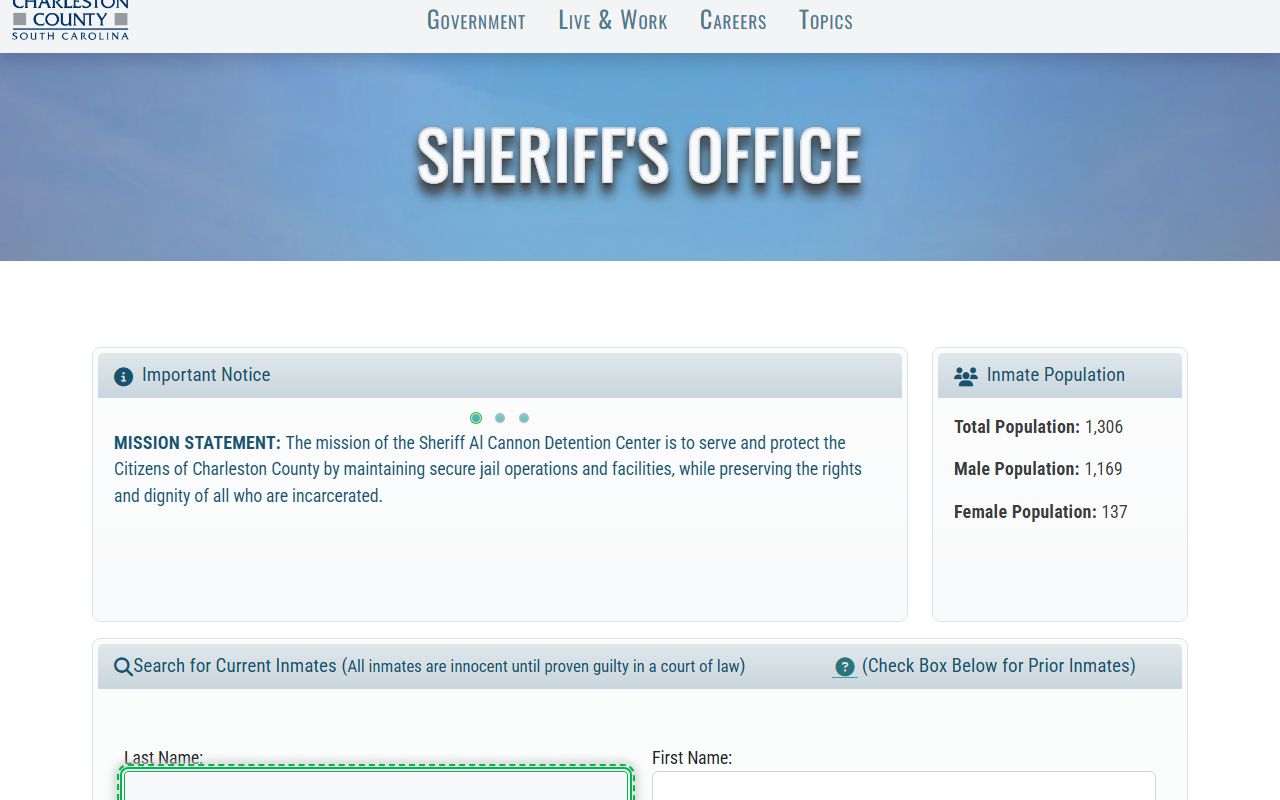
The form is more useful when booking date and arrest date are treated as separate filters.
Charleston County Roster Fields
Research confirmed the public search fields even though a sample profile could not be opened without a live reCAPTCHA search and a real result. The fields below are safer than guessing at profile data because they come from the official roster form itself.
| Field Label | Type | Required | Options / Format Notes |
|---|---|---|---|
| Last Name | Text | Unspecified | Primary name search field. |
| First Name | Text | Unspecified | Useful when the last name is common. |
| Booking Date From / To | Date picker | Optional | MM/DD/YYYY; datepicker limits range to the current day. |
| Arrest Date From / To | Date picker | Optional | Separate from booking date. |
| Enable Sounds Like | Checkbox | Optional | Soundex help is linked from the form. |
| Inmate Number | Text | Optional | Maximum length 10 characters. |
| Show Past Bookings | Checkbox | Optional | Unchecked is for current inmates; checked includes prior bookings. |
| reCAPTCHA | Widget | Required | The page alerts if verification is not completed. |
Charleston County Inmate Profile Data
The public profile display was not captured during research, so the safest field inventory combines confirmed roster inputs with official processing and detention details. SACDC photographs and fingerprints all booked inmates, assigns each inmate a PIN for phone and commissary access, uses an inmate number for armbands and kiosk functions, and routes the person through classification before bond hearing. Mail and money rules require the correct name and ID number, which makes the inmate number a practical record key.
| Field | What It Shows |
|---|---|
| Last Name / First Name | Searchable identifiers on the county roster. |
| Inmate Number | Local jail identifier used for search, mail, deposits, armband, and kiosk access. |
| Booking Date | Jail intake timing filter in MM/DD/YYYY format. |
| Arrest Date | Date law enforcement took the person into custody. |
| Current / Past Booking | Shows whether the search is aimed at current custody or prior bookings. |
| Photo / Fingerprints | CCSO processing confirms all inmates are photographed and fingerprinted, though public photo display was not confirmed. |
| Bond Status | Processing research confirms bond hearing occurs after intake and JMS entry. |
Charleston County Booking Process
The CCSO processing page gives a detailed local intake workflow. After an arresting agency brings a person to SACDC and charges are reviewed, staff search the person, inventory property, take photographs and fingerprints, assign a PIN, permit free phone-call access during intake, interview the inmate for classification, conduct nurse screening, and prepare bond-hearing paperwork in the Jail Management System. The final processing step is dress-out, when uniforms, linens, and hygiene items are issued.
This process explains why a brand-new arrest may not show online right away. Transport, charge review, search, property intake, photo and fingerprint work, medical screening, classification, and bond paperwork all happen before the record is fully settled. For urgent confirmation, use the jail phone line rather than assuming one failed web search means the person is not in custody.
The official processing page screenshot is tied to the intake sequence.
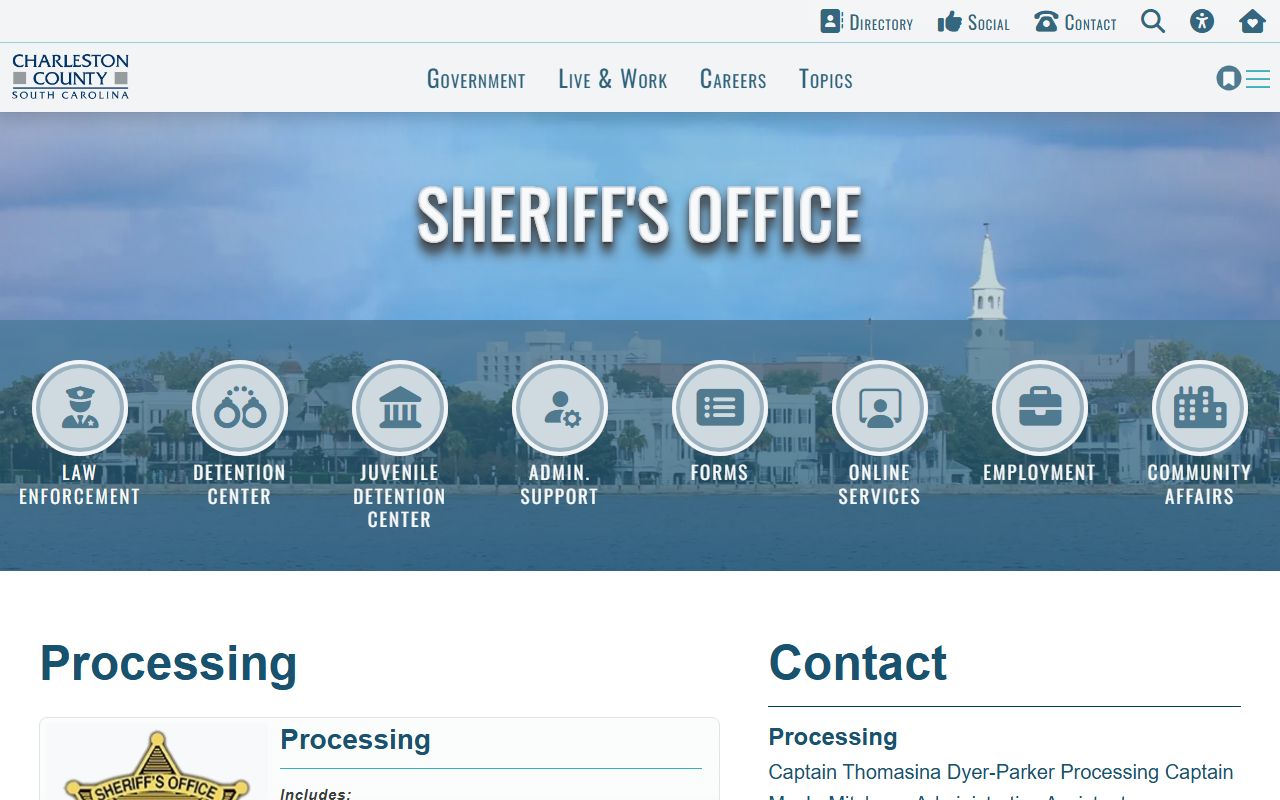
The processing details are useful when roster timing and bond-hearing timing do not match a family's expectations.
Charleston County Jail Facilities
Sheriff Al Cannon Detention Center is the adult facility tied to the public roster. Charleston County Juvenile Detention Center is a separate juvenile facility under the sheriff's detention umbrella. Juvenile custody records are not treated like adult jail roster records, so guardians, attorneys, and authorized parties should use juvenile and court-authorized channels rather than the adult inmate search.
Sheriff Al Cannon Detention Center
3841 Leeds Ave.
North Charleston, SC 29405
(843) 529-7300
Adult jail roster and detention information line.
Charleston County Juvenile Detention Center
Near the Leeds Avenue detention complex
North Charleston, SC
(843) 529-7300 general detention contact
Juvenile records are not public adult roster records.
Charleston County Visitation Rules
SACDC uses video visitation to reduce contraband and inmate movement. Personal visitation is online only except for attorneys, and an inmate must be incarcerated at least 72 hours before receiving a visit. Visitors set up an account through Securus. Out-of-state visitors with out-of-state picture ID may receive one unscheduled visit if space is available. Visitors suspected of being under the influence may be refused, and clothing rules prohibit halter tops, underwear-type t-shirts, tank tops, fishnet shirts, see-through clothing, and any visit without shoes and shirt.
| Visit Type | Days | Times / Limits |
|---|---|---|
| Attorney in-person visitation | Monday-Friday except county holidays | 9:00-11:00 AM; 1:30-4:00 PM; 7:00-10:00 PM |
| Personal online visitation | Sunday-Saturday | Maximum three 30-minute visits per seven calendar days |
| Morning personal block | Sunday-Saturday | 8:00-10:50 AM, last schedule 10:20 AM |
| Afternoon personal block | Sunday-Saturday | 1:00-4:25 PM, last schedule 3:55 PM |
| Evening personal block | Sunday-Saturday | 7:00-10:00 PM, last schedule 9:30 PM |
Charleston County Mail and Money
SACDC is cashless. Inmates use the inmate number on the armband and birth date at housing-unit kiosks to place commissary orders. Weekly commissary spending is capped at $100. Deposits can be made through the lobby kiosk, U.S. Mail money order, or TouchPayOnline.com using site number 229405. Cash and personal checks should not be mailed. Money orders must be made out to Sheriff Al Cannon Detention Center and include only the inmate's name and number on the memo line.
| Service | Provider / Detail |
|---|---|
| Money order mail | Inmate Name and ID#, Charleston County Detention Center, 3841 Leeds Avenue, North Charleston, SC 29405 |
| Personal mail | Securus Digital Mail Center, PO Box 20207, Tampa, FL 33622, with incarcerated individual and ID number |
| Online deposits | TouchPayOnline.com, site #229405 |
| Phone and tablet funds | Securus, customer service (800) 844-6591 |
| Commissary cap | $100 weekly spending cap |
Charleston County Lookup Fallbacks
The full access chain matters because the roster is only one channel. Call SACDC at (843) 529-7300 or use the after-hours sheriff number at (843) 202-1700 when immediate custody confirmation is needed. Visit or contact the jail when the web search fails and the situation is urgent. For detention or law-enforcement records, use the CCSO records process because the Charleston County FOIA Request Center says law-enforcement FOIA must go to the responding agency.
Sentenced state prisoners should be searched through the SCDC public incarcerated inmate search. Federal inmates belong in the BOP inmate locator, while immigration detainees may be searched through ICE ODLS. For notifications, South Carolina VINELink and VINE phone registration at (866) 727-2846 are the relevant custody-notification channels.
Charleston County also has municipal law-enforcement nuance. CCSO states that deputies have countywide authority, but they generally do not answer routine non-emergency calls inside municipal police jurisdictions unless requested or needed for public safety. That means an arrest by Charleston Police, North Charleston Police, Mount Pleasant Police, or another municipal agency may create an incident report with that agency, even though the person is booked at SACDC. The jail roster answers custody. The responding agency may hold the incident report. The court index answers filed charges and outcomes.
- Detainer
- A legal hold from another agency that can block release even when a local bond is posted.
- Classification
- The jail process that uses interviews and other information to assign custody level and housing.
- PR bond
- A personal recognizance bond, which allows release without paying a money bond if the judge permits it.
- Disposition
- The court outcome needed for many record-clearing and expungement questions.
Note: Confirm custody with the jail before sending money, scheduling a visit, or relying on a new booking search.