
Charleston County Court Records After Arrest
The Charleston County arrest-to-court path starts with the arresting agency and SACDC intake. The jail processing page covers search, property inventory, booking photo, fingerprints, PIN assignment, classification, nurse screening, and bond hearing. Those steps create jail and booking records. Formal court records after a jail arrest start when the charge is filed, docketed, reviewed, amended, dismissed, indicted, or resolved in a court system.
The official inmate search page links to the South Carolina case-search gateway, and the local entry point is the Charleston County Public Index. The Public Index is the better source for court case number, court, filing date, charge text, charge status, court dates, disposition, and bond terms. For jail custody and booking timing, use Charleston County jail inmate records. For booking photos, use the Charleston County jail mugshots page.
Find Court Records After Arrest
Start with the court case channel once a jail booking has occurred. If the roster has a case number, use it. If not, search by defendant name and verify dates carefully. Common names can create false matches, and booking charges may not use the same wording as the formal court charge.
- Confirm custody, booking date, and any known case or charge details from the county jail roster.
- Open the South Carolina Judicial Branch case search or the Charleston County Public Index.
- Search by defendant name, and use case number when known.
- Review court, filing date, charge text, status, bond conditions, court dates, and disposition.
- Compare roster charges with court charges because the solicitor or charging agency may amend, reduce, add, or dismiss charges.
The official Charleston County Public Index screenshot is the court-search source for this page.
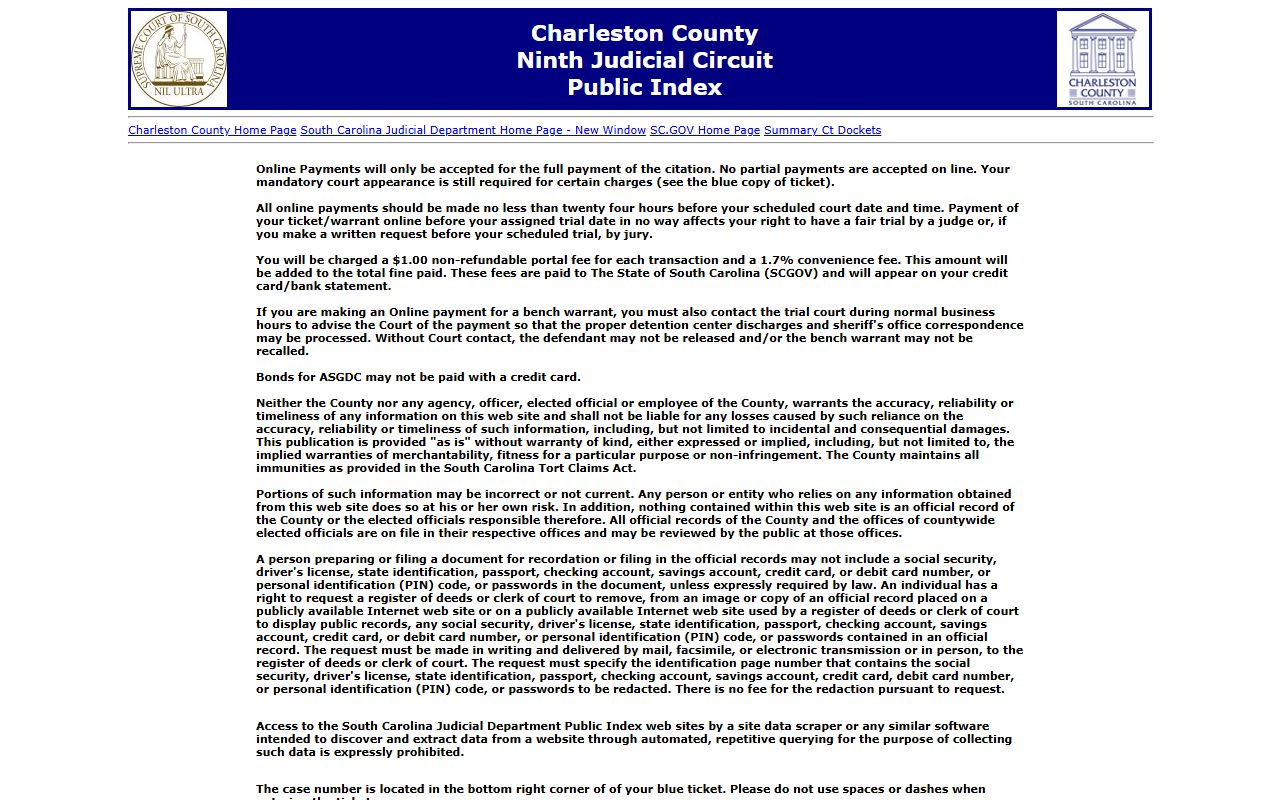
The Public Index is separate from the jail roster, which is why both systems may need to be checked after an arrest.
Charleston County Court Search Fields
The court-search form was only partially inspectable in the research environment, so exact field labels should not be overstated. The official path and safe search concepts are clear: use the county-specific Public Index, search by party or defendant name, use case number if known, and filter by court or date only when the live portal makes those options available.
| Search Point | Type | Use | Research Note |
|---|---|---|---|
| County / Public Index location | County-specific portal | Charleston County court records | Official Public Index URL captured. |
| Defendant / party name | Text | Best when no case number is known | Verify matches carefully for common names. |
| Case number | Text | Best when known from paperwork or court notice | Reduces false matches. |
| Court or case type | Filter | Useful for General Sessions, magistrate, or municipal context | Exact live options were not inspected. |
| Date range | Date filter | Useful after a recent arrest | Verify labels in the live portal. |
Ninth Circuit Court Records Role
South Carolina uses circuit solicitors rather than district attorneys. Charleston County is in the Ninth Judicial Circuit with Berkeley County. The Ninth Circuit Solicitor's Office names Scarlett A. Wilson as Solicitor and lists case information, bond revocation and modification motions, case search, FOIA request, dockets, bond court, General Sessions, preliminary hearing court, expungements, and victims and witnesses.
For many felony and serious misdemeanor matters, the solicitor is the office involved in prosecution after a Charleston County arrest. Summary and municipal matters may route through magistrate or municipal courts. The jail booking charge is the arrest-side label. The court record after the arrest is where the filed charge, hearing schedule, docket movement, plea, dismissal, conviction, or disposition should be checked.
The official Ninth Circuit Solicitor site screenshot shows the prosecutor's Charleston and Berkeley County role.
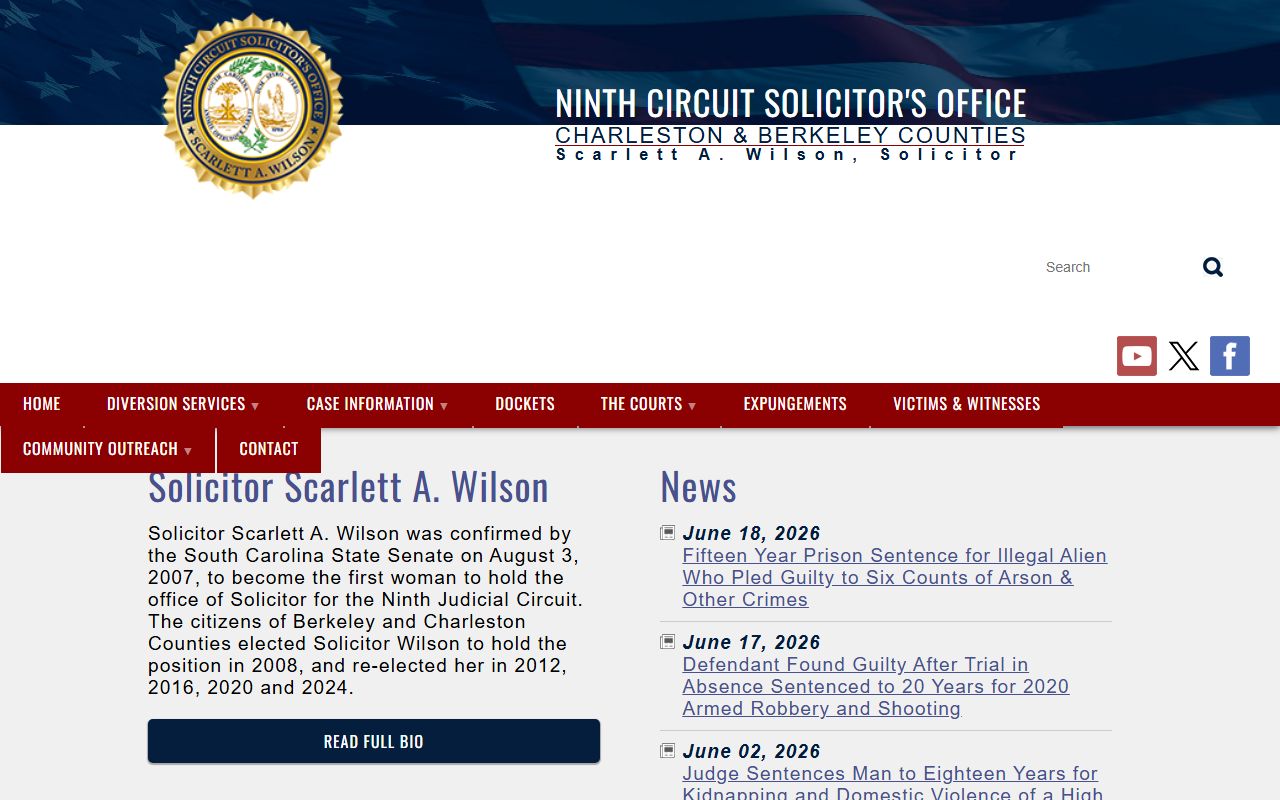
The solicitor site is also relevant when a person needs expungement eligibility or General Sessions docket information.
Charging Documents After Arrest
Charging documents explain why court records after an arrest can differ from jail records. A booking charge may be entered during intake, but prosecutors and courts can file or modify the formal court charge. South Carolina terminology and local practice should be checked against the actual case record, but three charging-document concepts help a reader understand the path.
| Document | Who Uses It | What It Does |
|---|---|---|
| Complaint | Law enforcement or prosecution path | Starts or supports a charge based on alleged facts. |
| Information | Prosecutor path | States formal charges without being the same as a jail booking entry. |
| Indictment | Grand jury path | Charges a case after grand-jury action, often in serious matters. |
Charge Status in Court Records
Charge status tells what happened after the arrest. A pending charge is unresolved. An amended or reduced charge means the formal accusation changed. A dismissal means the charge ended without conviction. A conviction means there was a guilty plea, verdict, or other qualifying disposition. The roster may still show booking history, but the court record is the source for outcome and status.
| Status | What It Means |
|---|---|
| Pending | The case or charge remains open and has not reached final disposition. |
| Amended | The charge text, code, degree, or count has changed after the initial filing. |
| Reduced | The charge moved to a lesser offense or lower severity level. |
| Dismissed | The charge was ended by the court or prosecution without conviction on that charge. |
| Disposed | The court record has an outcome, which must be read from the docket and disposition fields. |
Bond Court After Arrest
SACDC conducts all bond hearings by video conferencing. The Bond Hearing Department coordinates appearances before bond judges and enters paperwork into the Jail Management System. Family and friends may attend at Centralized Bond Hearing, 3870 Leeds Ave Suite 106, North Charleston, SC 29405. The Central Bond Hearing phone listed in the research is (843) 746-9822.
| Court / Hearing | Phone | Schedule |
|---|---|---|
| Central Bond Hearing | (843) 746-9822 | 7 days a week at 10:00 AM; Monday-Friday at 2:00 PM and 7:00 PM |
| City of Charleston | (843) 724-7160 | Monday-Friday at 1:00 PM and 7:00 PM; weekends and holidays at 8:30 AM and 2:00 PM |
| North Charleston | (843) 554-5700 | 7 days a week at 11:00 AM; weekends and holidays at 9:00 AM |
Bond status must be read with caution. A person can have a bond on one charge but remain in custody because of another charge, detainer, probation hold, parole hold, municipal hold, federal hold, or state transfer.
Warrants and Court Arrest Records
The CCSO Warrants Unit is located inside the main lobby of Sheriff Al Cannon Detention Center. The office maintains physical control of warrants and juvenile pickup orders received by the Sheriff's Office and verifies warrant information. CCSO cites South Carolina Code Section 23-15-50 for the sheriff's duty to arrest people for whom criminal process has issued. The warrants page warns that warrant information changes during the day and must be confirmed through the Sheriff's Office.
Normal business warrant inquiries go to (843) 529-7391. The page also lists (843) 743-7200 for consolidated dispatch, (843) 202-1700 for after-hours or non-business arrangements, and Warrants@CharlestonCounty.org. Bench-warrant and turn-in details are practical but sensitive, so use the official CCSO Warrants Unit page and court instructions before appearing in person.
Charges Versus Convictions
A Charleston County arrest can create a booking record and a court case without creating a conviction. The booking charge is an accusation or hold basis at intake. A court charge is the formal case allegation. A conviction is an outcome, usually after plea, verdict, or other court disposition. Treating all three as the same can lead to serious mistakes.
| Charge | Conviction | |
|---|---|---|
| Stage | Allegation in a criminal case | Final or qualifying court outcome |
| Where Seen | Jail roster and Public Index | Court disposition record |
| Can Change | Yes, it may be amended, reduced, or dismissed | Changes only through later court action |
| How to Verify | Compare roster and court case | Read the official court disposition |
Sealed and Expunged Arrest Records
South Carolina expungement applications are administered by the solicitor's office in each circuit under S.C. Code Section 17-22-910. The CCSO warrants FAQ route in the research tells people seeking to clear records to get a disposition from CCSO Records at 3505 Pinehaven Drive, North Charleston, SC 29405, then take it to the Ninth Circuit Solicitor at the O.T. Wallace County Office Building, 101 Meeting Street, Charleston, SC 29401, for eligibility review.
| Sealed | Expunged | |
|---|---|---|
| Public Visibility | Hidden or restricted from ordinary public view | Destroyed or removed as allowed by order and law |
| Where to Start | Read the court order and clerk record | Get disposition documentation and contact the Ninth Circuit Solicitor |
| Effect on Web Copies | Depends on source and order | Government records may change, but third-party copies need separate handling |
Restricted Court Records After Arrest
Not every record tied to an arrest is public. South Carolina FOIA exemptions may apply to law-enforcement records if release would interfere with proceedings, invade privacy, disclose sources or methods, endanger safety, or violate other law. Juvenile records are also treated differently from adult court and jail records. A Charleston County juvenile detention matter should not be searched or described as an adult jail roster case.
Important: Court records after arrest should be verified with the court or originating office before any legal or personal decision.