
The Charleston County Inmate Population
The Charleston County inmate population centers on the Sheriff Al Cannon Detention Center, the adult county detention center operated by the Charleston County Sheriff's Office. CCSO uses the facility for arrests that are searched, booked, photographed, fingerprinted, medically screened, classified, routed to bond hearing, and then released, transported, transferred, or archived. The adult jail count is not the same thing as the state prison count. Local pretrial detainees, short local sentences, municipal-court detainees, and some other lawful holds may be at the county jail, while sentenced state prisoners belong in the South Carolina Department of Corrections system.
The county also identifies the Charleston County Juvenile Detention Center under the sheriff's detention umbrella. That facility is part of the local custody map, but juvenile residents are not searched like adults on a public jail roster. This split matters when a search seems to fail. A person may be too new to show after booking, already released, moved to SCDC after sentencing, held federally, transferred to ICE, or involved in juvenile court where public access is limited.
Charleston County Inmate Population Statistics
Local inmate population figures come from two main sources. CCSO publishes a detention-center page with facility capacity and a point-in-time public population snapshot. The Charleston County Criminal Justice Coordinating Council publishes jail-use reports and annual reports that track average daily population, admissions, length of stay, charges, and case backlog. Those two sources answer different questions. A one-day website snapshot shows who was counted at that moment. Average daily population, often called ADP, smooths jail use across a year.
| Measure | Figure | Source / Date |
|---|---|---|
| Rated capacity, Sheriff Al Cannon Detention Center | 1,693 inmates | CCSO detention page, inspected June 29, 2026 |
| Current public snapshot | 1,307 total, 1,170 male, 137 female | CCSO detention page, inspected June 29, 2026 |
| 2024 local jail ADP | 1,114 | CJCC publications, 2024 Annual Report and Jail Use brief |
| 2024 local jail admissions | 8,370 | CJCC 2024 Jail Use brief |
| 2024 local charges | 18,723 | CJCC 2024 Jail Use brief |
| 2024 average jail length of stay | 28 days overall | CJCC 2024 Jail Use brief |
Charleston County Jail Population Trends
The Charleston County inmate population has moved upward in recent CJCC reporting, but it has not passed the older benchmark captured in the research. CJCC reported 973 local jail ADP in 2023 and 1,114 in 2024, while the 2014 benchmark was 1,189. The research also notes that CJCC defines the local jail population by excluding non-local jurisdictions in that annual-report context, such as federal government or non-Charleston County agency use. That makes the local ADP figure useful for county trends, but it should not be mixed with every bed filled on a single day.
| Year | ADP / Jail-Use Figure | Notes |
|---|---|---|
| 2014 | 1,189 ADP | CJCC benchmark used in the 2024 Annual Report. |
| 2023 | 973 ADP | CJCC 2024 Annual Report and Jail Use comparison. |
| 2024 | 1,114 ADP | Up from 2023 but below the 2014 benchmark. |
| Current CCSO page snapshot | 1,307 total | Point-in-time website count, not annual ADP. |
The CJCC Jail Use brief also reported that average length of stay fell from 35 days in 2023 to 28 days in 2024. General Sessions average stay was 53 days, Summary Court average stay was 11 days, and Federal Court average stay was 244 days for 42 people. These categories help explain why one hold type can affect jail beds more than another even when the person count is small.
Charleston County Inmate Population Makeup
The CJCC 2024 Jail Use brief is the main local source for demographic detail. It reported that the 2024 ADP was 91.73 percent male, that 60 percent of the ADP fell between ages 25 and 44, and that 67.5 percent was Black. Those are jail-use figures, not a statement about Charleston County's full population. Charge data also shifted in 2024. The research notes that DUI became the most frequently booked charge with 1,155 warrants after South Carolina's Constitutional Carry law changed the prior top-ten pattern.
- Sex distribution: CJCC reported 91.73 percent male ADP in 2024; the CCSO snapshot separately showed 1,170 males and 137 females.
- Age range: CJCC reported 60 percent of 2024 ADP was between ages 25 and 44.
- Race data: CJCC reported 67.5 percent Black ADP in 2024.
- Charge volume: CJCC reported 18,723 local charges in 2024, with 81.5 percent issued to males.
Charleston County Jail Capacity
SACDC has a detailed capacity history. The detention center was built in 1966, expanded in 1994 to 661 beds, expanded with two modular units in 2007 to 789 beds, and expanded again in May 2010 to 1,917. In 2020, the removal of two modular units and the Work Camp lowered capacity by 224, leaving the official stated capacity at 1,693. The current website snapshot in the research was 1,307, below stated capacity, while the 2024 local ADP was 1,114. The public figures still require care because ADP, stated capacity, and a one-day total each measure a different thing.
The building description gives local context for the count. Tower A contains training areas, staff spaces, an inmate library, logistics functions, and eight housing units. Towers B and C include administrative offices, a control center, kitchen, laundry, medical department, lobby, visitation area, twenty-one direct-supervision units, and a DHEC-licensed infirmary. CCSO states that more than 700 cameras are monitored through Central Control.
The official CCSO detention center page is the source screenshot for this section.
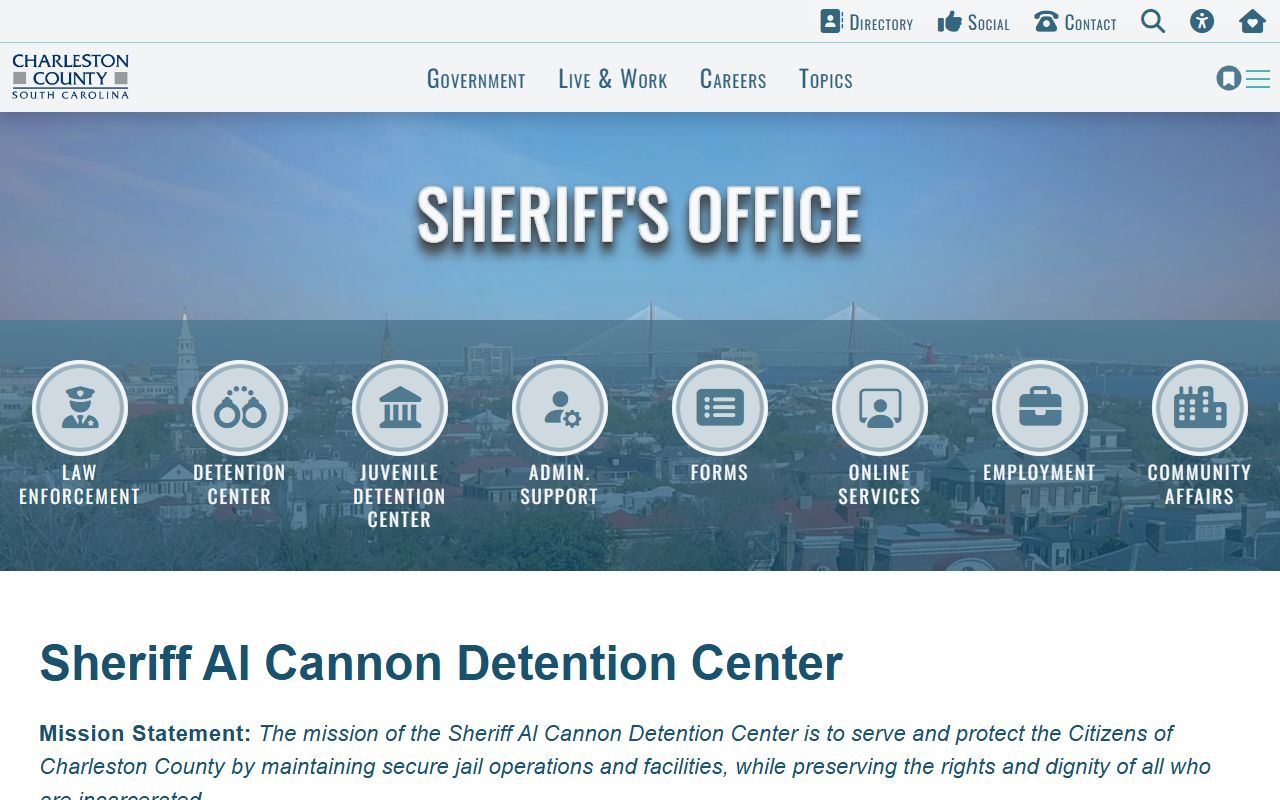
The screenshot helps distinguish the jail's public population snapshot from yearly CJCC jail-use figures used for trend analysis.
Laws for Charleston County Inmate Records
South Carolina public-records law gives the framework for jail population and inmate-identification access. It does not make every jail file public without limits. The same statute chapter that allows inspection also contains exemptions for law-enforcement records, privacy, safety, confidential sources, protected methods, and pending proceedings. Charleston County readers should treat the public roster as the first source, court records as the formal charge source, and a CCSO records request as the next step for records not visible online.
Key Statutes:
S.C. Code Title 30, Chapter 4 is the South Carolina Freedom of Information Act for public records.
S.C. Code Section 30-4-30 includes access to documents identifying people confined in a jail, detention center, or prison for the preceding three months when requested in person unless exempt.
S.C. Code Sections 30-4-40 and 30-4-50 pair law-enforcement disclosure duties with exemptions for records that cannot be released safely or lawfully.
S.C. Code Title 24, Chapter 5 addresses county jail custody duties and annual reporting on jail conditions.
Charleston County and State Prison
No South Carolina Department of Corrections prison was found inside Charleston County on the official SCDC institutions list. That does not mean Charleston County defendants never enter state custody. It means the lookup changes after sentencing and transfer. CCSO processing research says transportation staff handle transfers to SCDC, federal prisons, and other in-state or out-of-state facilities. Once a person is in state prison, the county jail roster is no longer the main search tool.
| Custody Stage | Primary Search Channel | What It Covers |
|---|---|---|
| County jail | Charleston County inmate search | Current inmates by default and past bookings when selected. |
| State prison | SCDC public incarcerated inmate search | Sentenced prisoners in state custody. |
| Federal prison | BOP inmate locator | Federal inmates from 1982 to present. |
| Immigration custody | ICE Online Detainee Locator | Immigration detainees after ICE custody transfer. |
Search Charleston County Inmate Population
The official jail roster is the Charleston County inmate search. It is a free county search form for current inmates, with an option to include past bookings. The form uses reCAPTCHA, so public results may not be accessible through automated tools. A human search should start broad, then narrow by date, Soundex, or inmate number when a name returns too many results.
- Open the official Charleston County inmate search page.
- Enter last name and first name if known. Use Soundex when spelling may vary.
- Add booking-date or arrest-date ranges in MM/DD/YYYY format for common names.
- Use the inmate number if a family member, attorney, bond company, or jail staff has provided it.
- Leave Show Past Bookings unchecked for current custody. Check it for released or older bookings.
- Complete reCAPTCHA and search. If there is no match, try fewer fields before assuming the person is not in custody.
When the county roster does not match, use the jail phone line, the records-request path, SCDC, BOP, ICE, and VINELink based on the person's custody stage.
Charleston County Roster Search Fields
The roster form gives more control than a simple name search. Booking date and arrest date are separate filters, which helps when the arresting agency brought the person to the jail on one date and the jail completed booking on another. The form also includes a Soundex option for names that sound alike. Inmate number is capped at 10 characters.
| Field Label | Type | Required | Notes |
|---|---|---|---|
| Last Name | Text | Unspecified | Start here for most searches. |
| First Name | Text | Unspecified | Use with last name when known. |
| Booking Date From / To | Date | Optional | MM/DD/YYYY datepicker with current-day maximum. |
| Arrest Date From / To | Date | Optional | Useful when arrest and booking dates differ. |
| Enable Sounds Like | Checkbox | Optional | Soundex search for spelling variants. |
| Inmate Number | Text | Optional | Maximum length 10 characters. |
| Show Past Bookings | Checkbox | Optional | Unchecked defaults toward current inmates. |
The official Charleston County inmate search page is shown below.
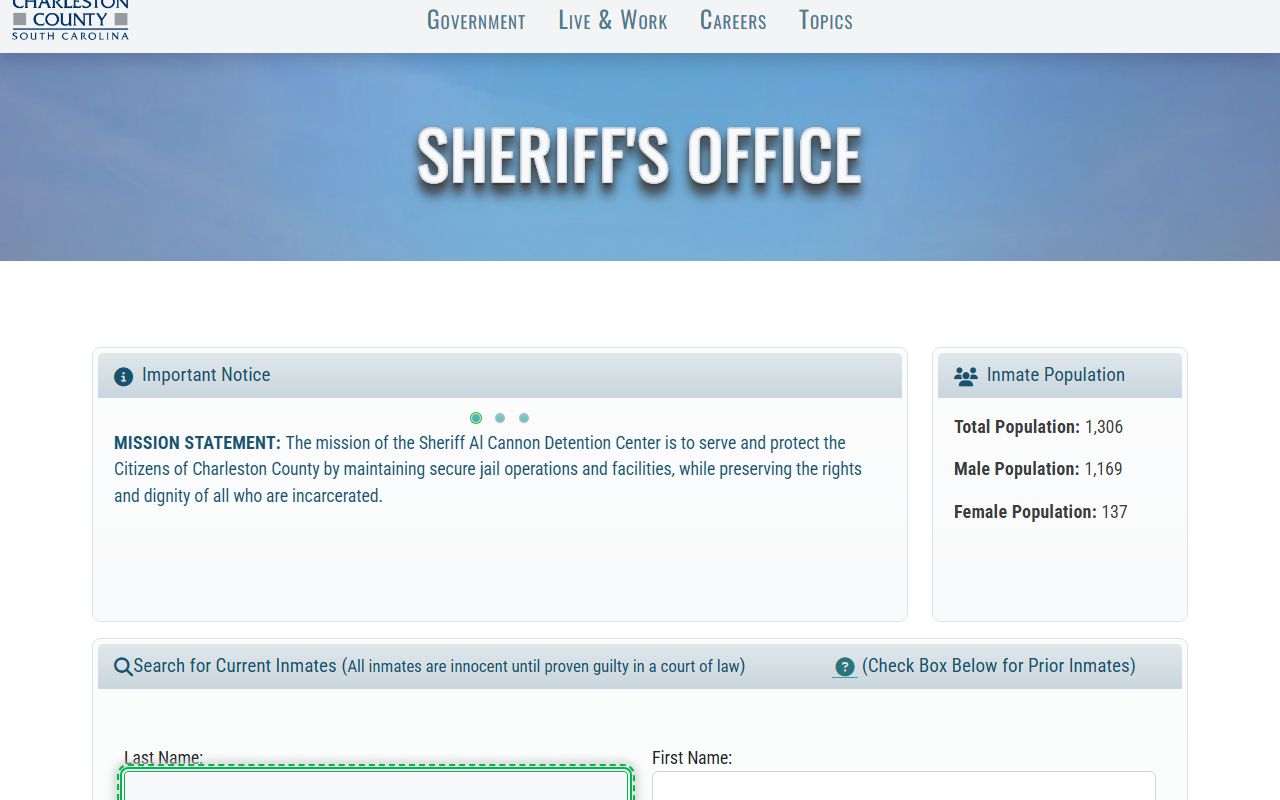
The screenshot shows why date filters and Soundex matter for the Charleston County inmate population search.
Past Charleston County Inmate Records
The roster has a Show Past Bookings checkbox, so it is not limited to current inmates when that option is selected. Past booking access still has limits. A person who is released, transferred, expunged, sealed, or held in another system may not produce the result a searcher expects. South Carolina FOIA allows access to certain jail-identification records, but law-enforcement exemptions can still apply, especially for investigative material, privacy, safety, and legally protected records.
For historical detention material, the county FOIA portal is not always the right first stop. The portal says Charleston County does not handle law-enforcement FOIA and points requesters to the responding agency for incident reports and similar records. If CCSO holds the detention or booking record, route the request through the sheriff's process rather than treating the general county portal as the final answer.
Charleston County Inmate Record Fields
A public sample profile could not be inspected during research because the search requires a live reCAPTCHA result. The confirmed public form fields and CCSO processing details still show how the record system is built. SACDC photographs and fingerprints booked inmates, assigns a PIN for phones and commissary, uses inmate numbers for mail and deposits, and routes the person through classification and bond paperwork.
| Field | What It Shows |
|---|---|
| Name | Last and first name are searchable on the official roster. |
| Inmate Number | Local identifier used for search, mail, commissary, armband, and kiosk access. |
| Booking / Arrest Date | Separate search filters that help distinguish jail intake from arrest timing. |
| Current vs. Past Booking | The checkbox controls whether prior bookings are included. |
| Booking Photo | SACDC takes photos during processing, but public display on each profile was not confirmed. |
| Charges and Bond | Booking charges and bond hearing status should be checked against court records. |
Charleston County Detention Facilities
The facility list for Charleston County is short, but the distinction is important. The adult jail is the public roster facility. The juvenile detention center is a separate custody setting tied to juvenile and family-court authority, and adult booking, mugshot, and roster assumptions should not be applied to juveniles.
- Sheriff Al Cannon Detention Center - the adult Charleston County jail for pretrial detainees, local sentences, bond processing, classification, court transport, and lawful holds.
- Charleston County Juvenile Detention Center - a juvenile detention facility under CCSO's detention umbrella, not a public adult jail roster facility.
Charleston County Inmate Population FAQ
How big is the Charleston County inmate population?
CCSO's detention page snapshot in the research showed 1,307 total inmates at SACDC, while CJCC reported 1,114 local jail ADP for 2024. Use the snapshot for a one-day count and ADP for trend analysis.
How do I search the Charleston County inmate population?
Start with the official Charleston County inmate search. Use last name, first name, date ranges, Soundex, inmate number, and the Show Past Bookings checkbox based on what is known.
What if the person is not listed?
Check intake timing, name spelling, past-booking status, SCDC for sentenced state custody, BOP for federal custody, ICE for immigration detention, and VINELink for notification status.
Does the adult roster include juvenile detention?
No public adult roster assumption should be made for juvenile residents. Juvenile custody records are handled through juvenile and court-authorized channels, not the adult inmate search.